
Microchip info
RFID Concept
Suppliers of Radio-frequency identification (RFID) Microchips in South Africa for Cattle, Game, Cats, Dogs, Stock and Horses.
- Radio-frequency identification (RFID) uses electromagnetic fields to automatically identify and track tags attached to objects. The tags (Transponder / Microchip) contain electronically-stored information which will be transmitted to a Reader when the reader energises the battery in the transponder.
For more info see here..
General Microchip information
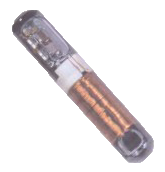
- The RFID transponder (also called “chip”) is a very small electronic wonder, packed in a bio glass capsule.
- The transponder is as small as a rice corn.
- The transponder contains a radio sender unit and a radio receiver unit.
- The transponder is coated with an anti-migration coating (the same material is used to coat pacemakers).
- The transponder is ISO compliant (11784/11785).
- The chip is injected under the skin of an animal and stays there for lifetime.
- The injection is as simple and harmless as a regular vaccination.
- The chip only becomes active when a reader transmits radio signals and activates the chip.
- The unique number can be read on the reader’s display.
- The transponder has no battery and can be read lifelong.
- The number of the transponder is stored in databases together with the personal details of the owner.
- The transponder has a worldwide unique number (300 billion possibilities).
Technical Characteristics
- Diameter : (2 x 13mm) & (1,4 x 9mm)
- Material : Bioglas, 8625
- Color : transparent
- Coating: parylene
- Passive transponder, only transmits when activated by a reader
- No battery needed (life long readable)
- Frequency : 134.2 kHz ± 6 kHz
- ISO compliant, ISO standard 11784/11785
- ICAR approved manufacturer
- Waterproof
- Resistance to immersion in salt water, alcohol, oil, 10% HCl and Ammoniac (t = 100 hours)
- Mechanical Shock IEC 68-2-29 (30g, 18ms, 3 axis x 1084 time/axis)
- Vibration IEC 68-2-6 (6g, 14Hz – 200Hz, 3 axis, 8h/axis)
- Thermal Storate range – 40° – + 90° Celsius, up to 1000 hours
- Operating range – 0° – + 50° Celsius
[caldera_form id="CF5c7ceb770e60b"]
Contact Us:
 [email protected]
Yvonne - 083.295.2008
Adelle - 063.852.6347
Fax - 086.584.6626
Register Login Pet Found Transfer Animal Available At Testimonials Microchips FAQ
Latest Information on COVID-19: